
Introduction of Tesla, Inc.
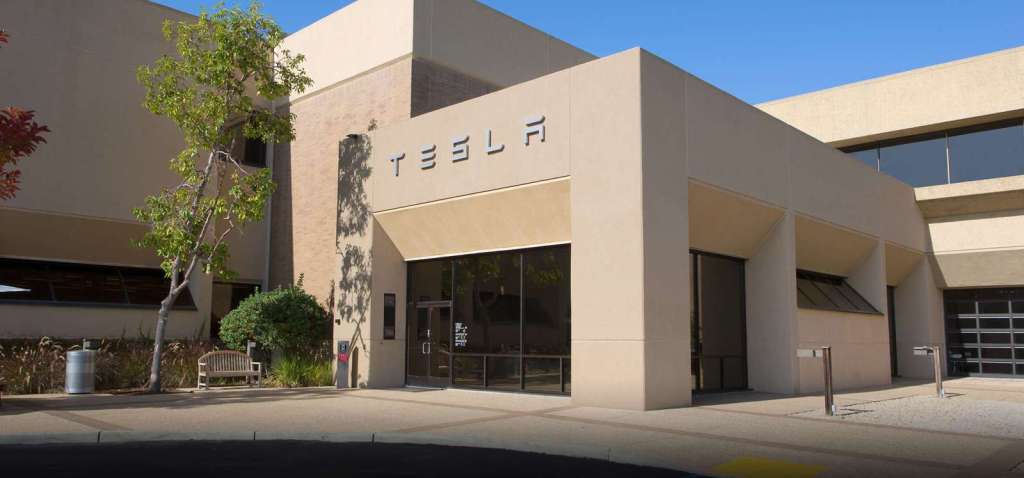
Tesla, Inc. is an electric vehicle (EV) and clean energy company based in America, which it initially specialized in battery energy storage and manufacturing EVs, and successfully expanded its business into solar panel and roof tile production. In midst of stiff competition among automotive manufacturers, Tesla’s co-founder and CEO, Elon Musk has taken his company to a whole new level of innovativeness and digitality by wholly embracing digital transformation and adopting a disruptive business model.
In the era of technological breakthrough, crowdsourcing has become increasingly common among corporations to utilize data and leverage all resources to their own advantage. Its practice basically involves acquiring information and work through data collection via the Internet or social media, in order to accelerate the organization’s progress in innovation and problem-solving. In light of this, Kleeman et al. (2008) stated that crowdsourcing is a form of integration of users or consumers in internal processes of value creation, with the intention of animating individuals to make a contribution to the firms’ production process for free or significantly less than that contribution is worth to the firm.
Capitalizing on crowdsourcing, Tesla has been collecting data from its vehicles and drivers through the internal and external sensors, like the tracking system and steering wheel (Marr, 2018). All the data are utilized to refine its system by generating data-oriented maps and establishing an extensive network of Tesla vehicles; on top of that, this approach helps to gather drivers’ data of driving patterns for advancing its AI technology and machine learning model, where Tesla has developed innovative features of “Autopilot” and “Full Self-Driving Capability”, with the ultimate aim of creating fully self-driving autonomous cars in the near future.

Digital Marketing and Retailing
Different from the conventional marketing approach in automotive industry, Tesla has been orienting its promotion to social media platforms, such as Twitter, where customers can freely interact with the company and directly communicate with its CEO. This newfangled marketing model has been successful in retaining old customers and attracting new customer segments, as well as gaining overwhelming attention from the media. It is also noteworthy that Tesla’s advertising spend is less than $6 per vehicle, considerably lower than that of other manufacturers (Venters and Sorensen, 2020). Based on this approach, it is seen that Tesla has been actively utilizing digital platforms to publicize its new products with the minimal expenditure and maximal marketing effects.
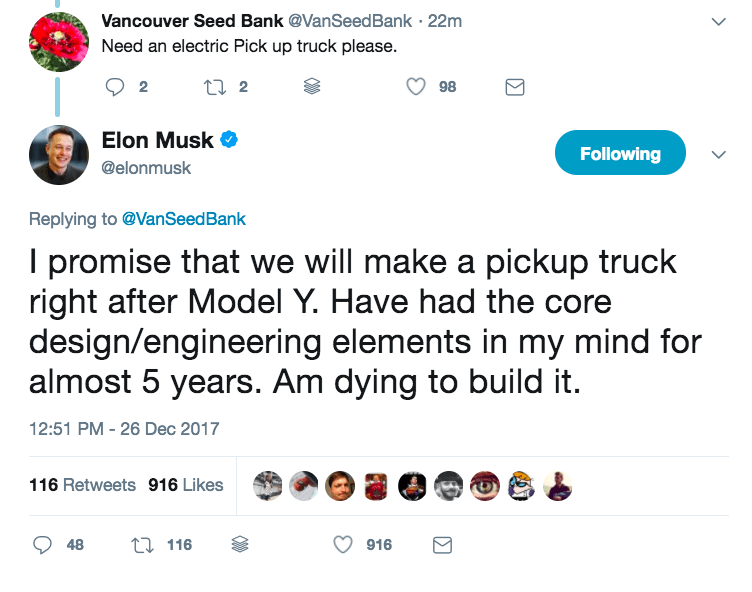
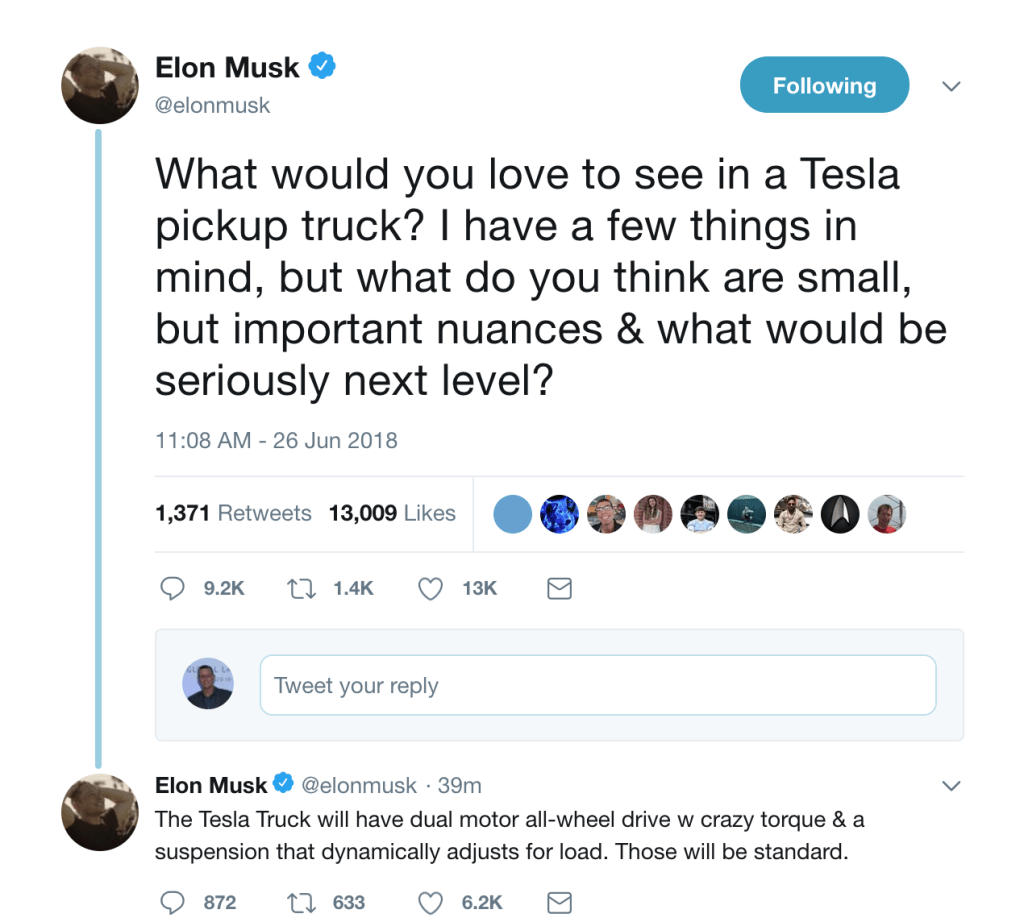
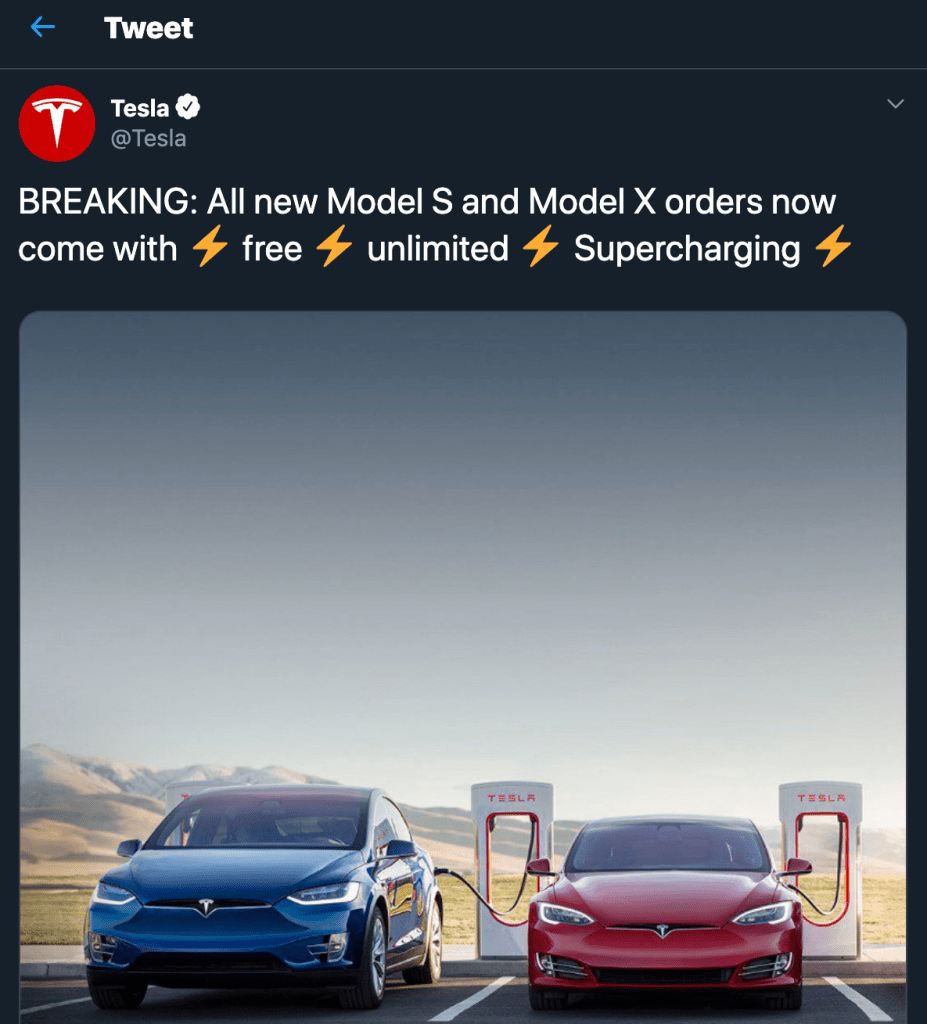
(Middle) Musk asked for customers’ opinions on design of brand-new vehicle model on his personal Twitter account.
(Right) Tesla has been tweeting the latest news on its products and services, where customers are free to leave any comment or retweet the post.
Apropos of Tesla’s distinct retailing strategy, Chen and Perez (2017) propounded that it has adopted a multi-channel model of both online stores and retail outlets, where customers can choose to directly purchase their vehicles online or at its own branded stores. On its official website, customers can freely select and customize their favored vehicle models by going through the following process:

1. Select the desired model and package of different practical functions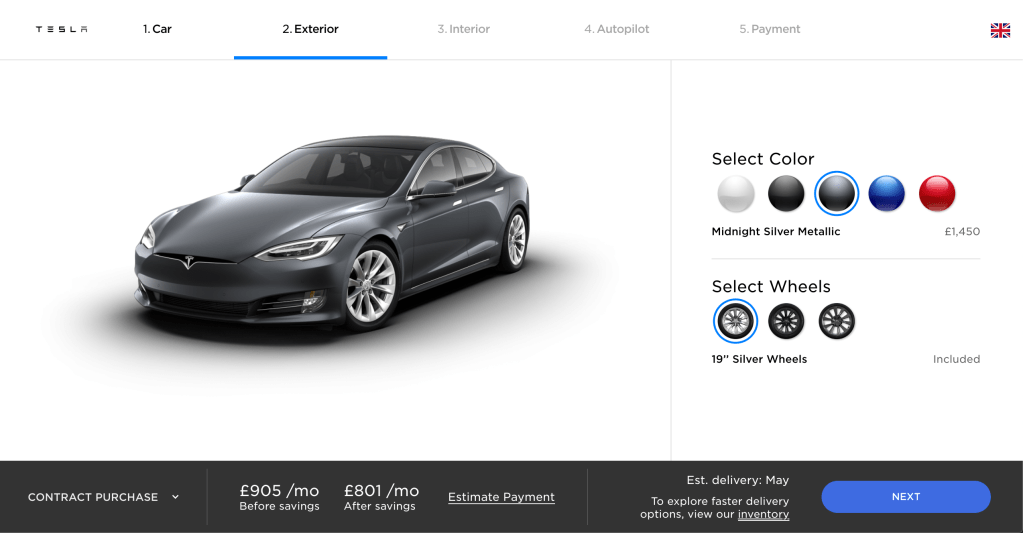
2. Select exterior features of color and wheels 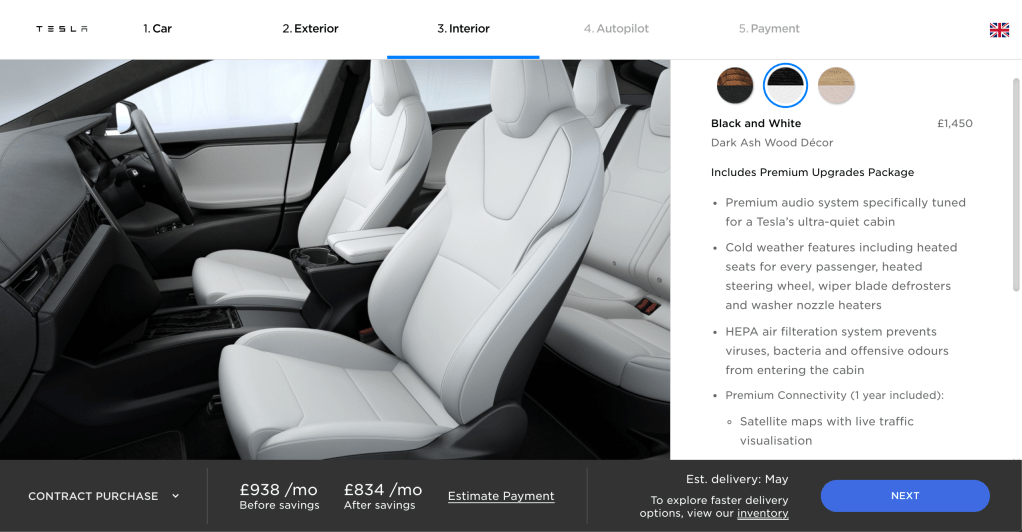
3. Select interior features of seats, audio systems, glass roofs and other parts of the cabin 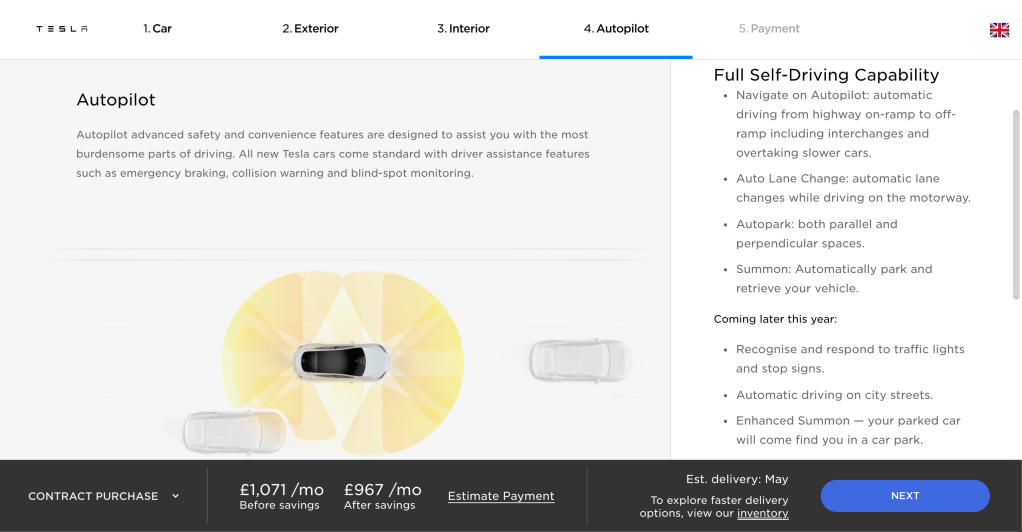
4. Select the option of Full Self-Driving Capability 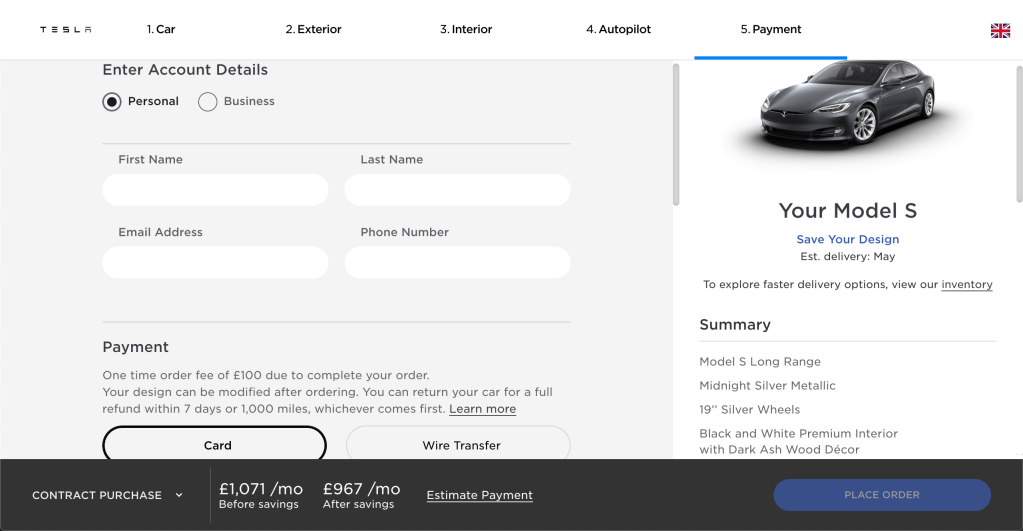
5. Payment with the estimated date of delivery provided
Through this online distribution model, Tesla does not have to spend extra money on car dealership with traders and all sales revenue is directly going into its account. In 2019, Tesla announced to be shifting most sales to online, with a reduction in number of physical showrooms and sales staff, leaving only few left as galleries and information centres. Meanwhile, customers can also complete their purchase on computers at company stores. As Lavietes (2019) asserted, consumer advocacy groups regarded this act as “consumer-friendly” by discarding the role of dealers and handing more control over to consumers. Likewise, technological experts also favored this model by considering it as strongly competitive long-term strength. In a nutshell, the online-oriented model does not only attain higher revenue and trim enormous amount of sales labor costs, it also brings an inclusive and disruptive experience of designing and creating their very own unique cars to customers.
Digitizing Products and Services
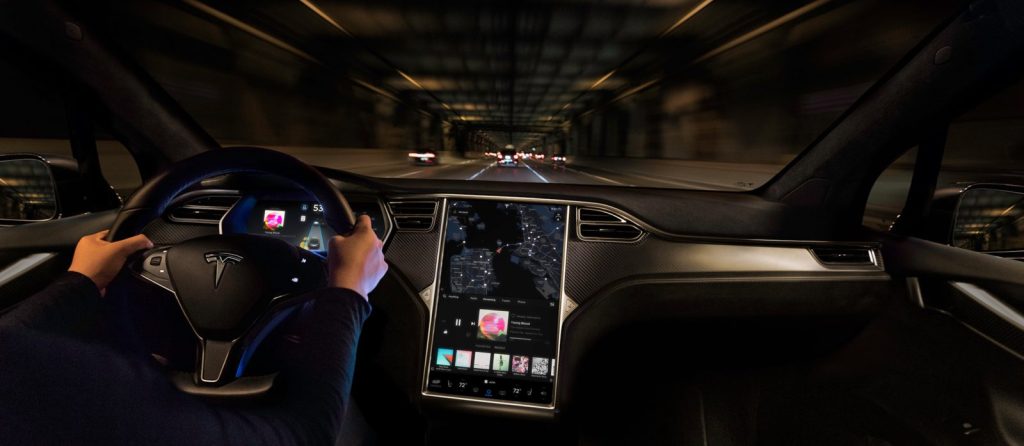
As one of the innovative leaders in automotive industry, Tesla has been consistently digitizing its products through installing sophisticated device and setting network connection inside its vehicles. In specific, Tesla has been way ahead in the “infotainment” race of which it has provided a basket of in-car entertainment services for the users. For instance, the dashboards inside its cars provide access to Spotify, Netflix, Hulu and YouTube accounts, as well as various arcade games. Speaking of which, Butler (2019) distinguished Tesla’s infotainment system from other manufacturers’ in which Tesla develops and possess its own system, whereas others are in collaboration with third-party platforms, hinting at another possible source of income for Tesla.
In addition to the infotainment system, Tesla also developed its own mobile app for users to remotely control and monitor their cars, with features like keyless driving, range distance, climate control and GPS location, providing all-embracing services to its users.
Future of Tesla, Inc.
In spite of its pioneering ideas and products that enlist devoted support from its users and draw media attention, Tesla has been having inauspicious performance in its finance for the past few years, as the company has not been generating net profit on yearly basis for the past few years. Although this has raised concerns among its users and investors, its ingenious and trendsetting model has undoubtedly expanded its base of loyal customers and become the exemplar within the automotive industry.
At the moment, the future of automobiles is still erratic, whether electric cars will be gradually replacing the conventional ones, or most production lines of vehicles will be automated by robotic technology. However, one thing is absolutely certain – Tesla is at the cutting edge of manufacturing electric vehicles and it has brought a new wave of digital disruption to the industry.
What is your thought on Tesla’s digital business model? Do you think that it is effective for sustainable development or is there any area that Tesla can do better in order to stay invincible as a leader in electric car industry?
Reference:
Boudette, N. E. (2018, Jun 30). Inside Tesla’s Audacious Push to Reinvent the Way Cars Are Made. The New York Times. Retrieved from https://www.nytimes.com/2018/06/30/business/tesla-factory-musk.html
Butler, C. (2019, Nov 23). Tesla’s plan to leave the auto industry behind on in-car infotainment. CNBC. Retrieved from https://www.cnbc.com/2019/11/23/teslas-plan-to-leave-auto-industry-behind-on-in-car-entertainment.html
Chen, Y., & Perez, Y. (2018). Business model design: lessons learned from Tesla Motors. In Towards a Sustainable Economy (pp. 53-69). Springer, Cham.
Design Your Model 3 Tesla. Retrieved from https://www.tesla.com/en_GB/model3/design#battery
Kleemann, F., Voß, G. G., & Rieder, K. (2008). Un (der) paid Innovators. The Commercial Utilization of Consumer Work through Crowdsourcing. In Science, Technology & Innovation Studies 4 (1), с. 5-26.
Lavietes, M. (2019, Apr 4). Tesla’s move to online sales gives customers what they want: No car salesman. CNBC. Retrieved from https://www.cnbc.com/2019/04/05/tesla-online-sales-gives-customers-what-they-want-no-car-salesman.html
Marr, B. (2018, Jan 8). The Amazing Ways Tesla Is Using Artificial Intelligence And Big Data. Forbes. Retrieved from https://www.forbes.com/sites/bernardmarr/2018/01/08/the-amazing-ways-tesla-is-using-artificial-intelligence-and-big-data/#2e2ae3824270
Venters, W., & Sorensen, C. Driving Digital Transformation at Tesla. Retrieved from https://www.thefuturefactory.com/blog/tesla
 Jacqueline's blog
6 replies on “How has Tesla’s digital business model paved its way to success?”
Hi Jacqueline,
Your post clearly demonstrates the technological leapfrogging and business disruption that has been done by Tesla to accelerate the advent of sustainable transport. Integrating the customers as part of the value chain is indeed a smart move by the company. Also, you mentioned how gathering data of driving patterns helped Tesla to bring ‘Auto-pilot’ and ‘Full Self-Driving mode’. However, there is a debate that the latest update still has safety concerns, according to CNBC news. Also, Tesla’s vertically integrated manufacturing to direct sales channel strategy made it unique, and it indeed helps to increase the overall customer experience. However, one challenge is that innovative new products often get skeptic responses from customers, as Model 3 car of Tesla last year lost its recommendation due to feedback from “Consumer Reports’ annual reliability survey”. What else do you think Tesla can incorporate in its business model to address these issues?
Sources:
Tesla is having another chaotic year — these are the biggest challenges Tesla has faced so far in 2019. (2019). Retrieved 11 March 2020, from https://www.businessinsider.com/teslas-biggest-challenges-in-2019-2019-3?r=US&IR=T
Turner, A. (2019). Consumer Reports says Tesla’s new autopilot setting raises ‘serious safety concerns’. Retrieved 11 March 2020, from https://www.cnbc.com/2019/05/22/consumer-reports-says-teslas-autopilot-raises-serious-safety-concerns.html
LikeLike
Hi Jacqueline,
Interesting post! I do agree with you that Tesla not only uses artificial intelligence, machine learning and other digital technologies in their products but also differs from traditional auto retailers in marketing and retail mode. As you said, by reducing the physical stores, Tesla greatly reduces the cost of sales and the impact of dealers on the price. In terms of marketing, compared with the traditional auto retailers’ practice of investing a lot of cost in advertising, Tesla focuses on the interaction with customers on social platforms. This marketing method not only saves costs but more importantly, this communication method is not a linear model, Customers and retailers can get timely feedback from each other. This marketing method is more targeted, and also reflects Tesla’s innovative brand image.
LikeLike
Hi Jacqueline,
I thoroughly enjoyed reading your blog post about Tesla. I was particularly surprised to learn that the company spends less than $6 per vehicle on advertising. The revelation shows the impact of social media on the cost of running enterprises today. It is enough proof that times are changing, and companies must adjust their operations to fit the current business environment if they wish to compete effectively. If using social media can save a firm millions of dollars on advertising, then companies should invest more in digital marketing as a long-term cost-cutting measure. Additionally, CEOs should also aim to create a robust online presence, for I believe that Elon Musk’s fascinating Twitter persona has, in one way or another, contributed to the success of Tesla’s social media marketing efforts.
LikeLike
[…] (Link of 1st comment of Post 3 for grading: Click Here) […]
LikeLike
[…] Lai, J. (2020, March 29). How has Tesla’s digital business model paved its way to success? Jacqueline’s Blog. Retrieved from https://jacquelinelaiphotography.photo.blog/2020/03/03/how-has-teslas-digital-business-model-paved-i… […]
LikeLike
[…] only focus on existing profit but also analyse the trend and optimise its business model. Jacqueline’s blog showed me a typical case of how to implement marketing strategies. And I study the case of Argos […]
LikeLike